
Fabric Calculator
Buying too little fabric means a second trip and a dye-lot mismatch; buying too much wastes money. This calculator works out how much fabric you need for the most common projects — curtains, quilt backing, cushion covers and tablecloths, or any list of rectangles — for your fabric’s width, including hems, seams, fullness and pattern repeat.
- Free to use
- No sign-up
- Runs in your browser
Fabric yardage calculator
Sewing Project Planner Pack
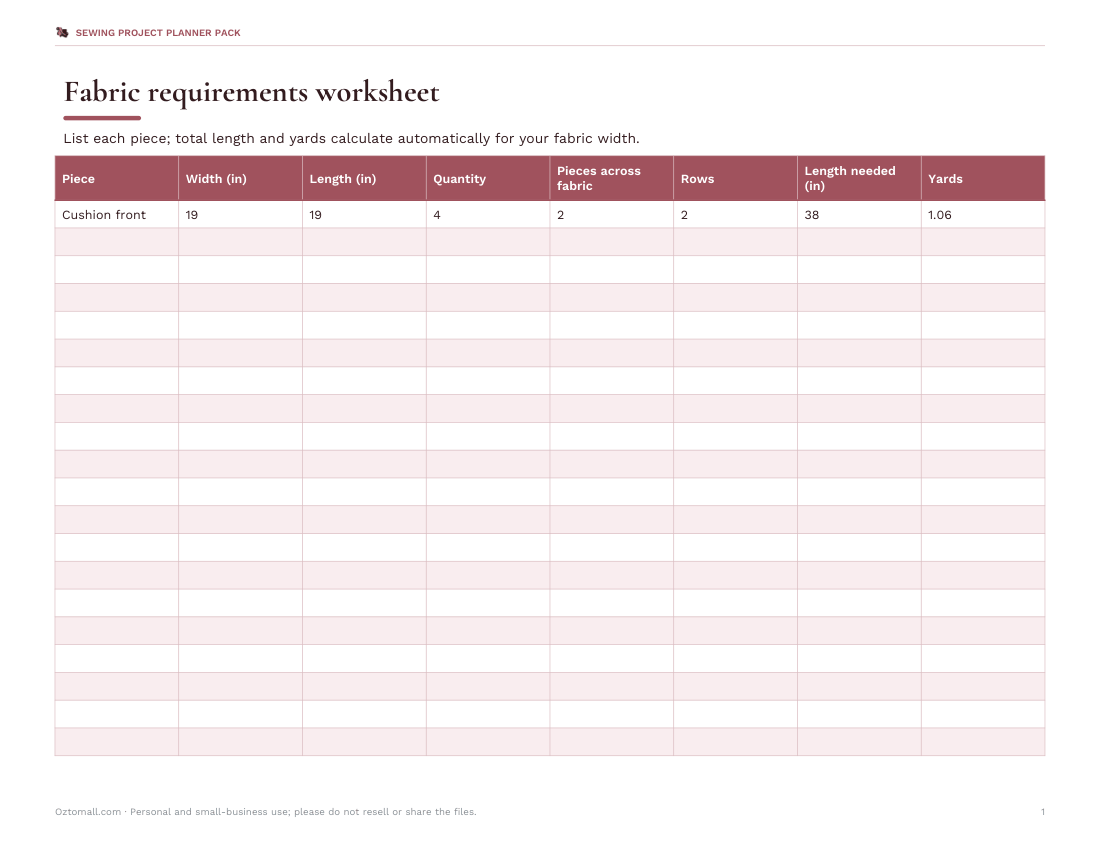
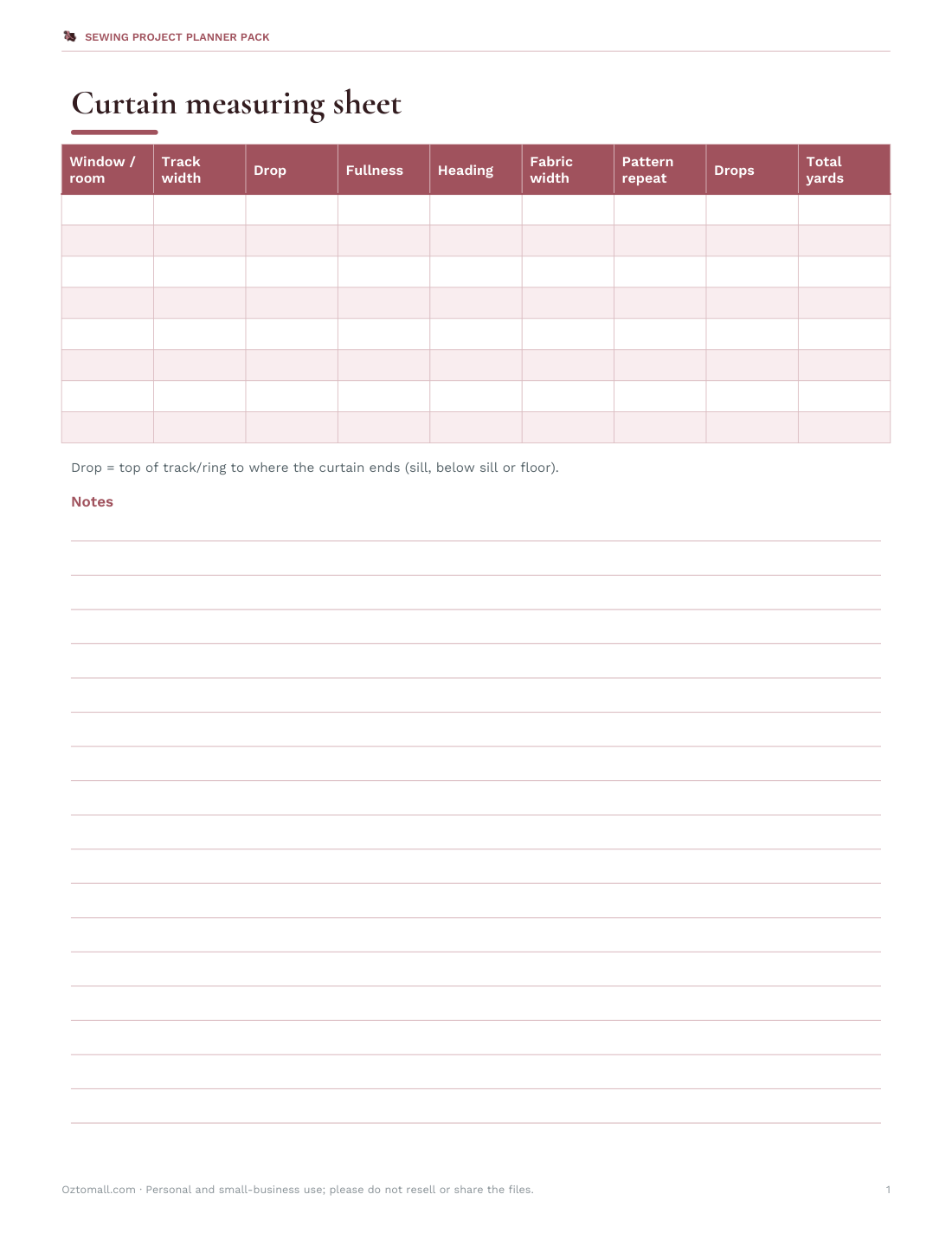
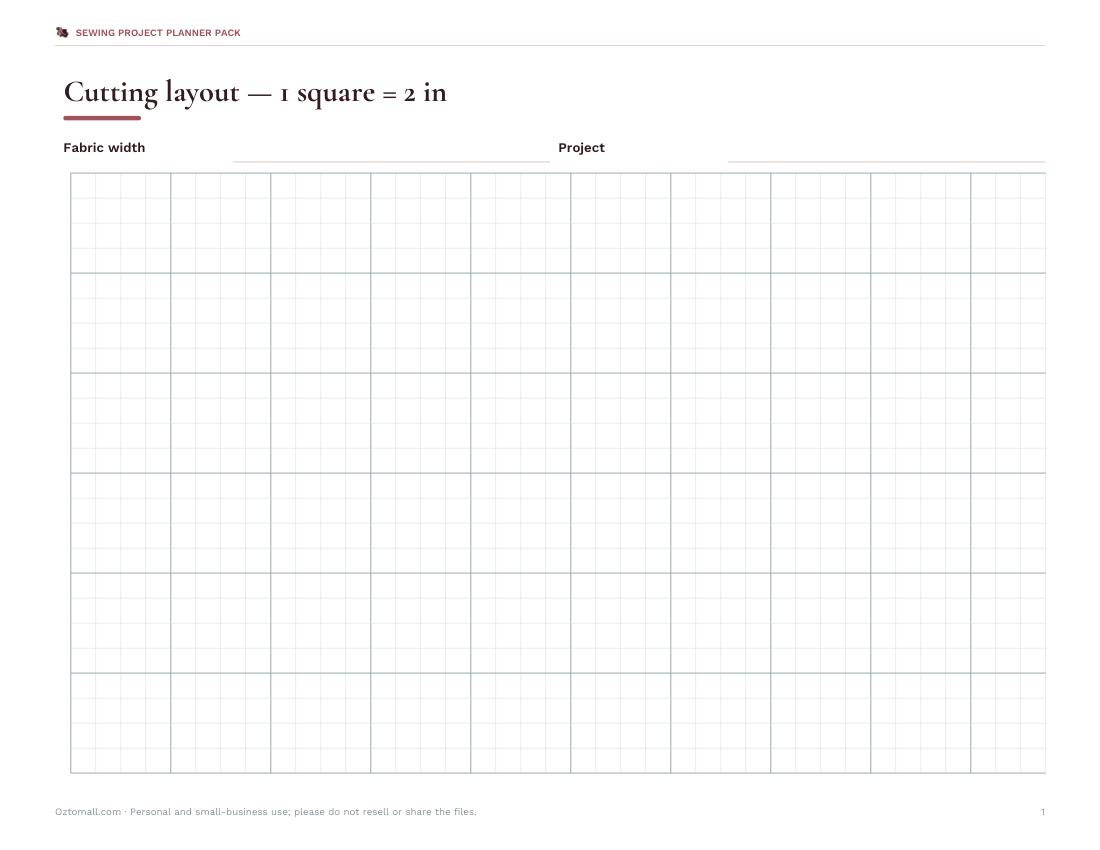
Printable fabric requirements worksheet, a curtain measuring sheet, a cutting layout grid and a sewing project planner with a supplies checklist.
- Fabric worksheet (XLSX)
- Curtain sheet (PDF/DOCX)
- Cutting grid (PDF)
- Project planner (PDF/DOCX)
Formats: XLSX, PDF, DOCX. Instant download after payment (link valid 72 hours, up to 5 downloads). AI-assisted: the templates were drafted with AI help and reviewed and laid out before publishing.
$5.00 USD, one-time 4 files · about $1.25 each
- Instant download
- 7-day refund
- Secure checkout by Stripe
7-day money-back guarantee. Full refund within 7 days of purchase, even after you download.
Free sample: Fabric Requirements (PDF, 58 KB)
Full refund within 7 days — see the refund policy and license.
Free printables
Single sheets you can print right now, no sign-up. The full pack adds every sheet in one download plus the editable files.
 Printable Fabric Requirements Worksheet
 Printable Curtain Measuring Sheet
 Printable Fabric Cutting Grid
 Printable Sewing Project Planner
How much fabric for curtains
- Measure the rod or track width and the finished drop (length).
- Multiply the width by the fullness: 1.5–2× for most curtains, 2.5–3× for sheers.
- Divide by the usable fabric width to get the number of widths (drops), rounding up.
- Add hem and heading allowances to the drop — often 12–20 in (30–50 cm) in total, depending on the heading.
- If the fabric has a pattern repeat, round each cut length up to a whole number of repeats and add one extra repeat for matching.
- Multiply the number of drops by the cut length.
Pinch pleats and pencil pleats need more fullness than tab tops or eyelets; check the heading tape instructions.
Worked example: a pair of curtains
A 72-inch track with 2× fullness needs 144 inches of fabric width. With 54-inch fabric (about 52 inches usable after side seams), that is 144 ÷ 52 = 2.8, rounded up to 3 widths — so 2 per panel for a pair, 4 drops in total. Each drop is 84 + 16 = 100 inches. Four drops × 100 inches = 400 inches, about 11.1 yards; with 10% extra for shrinkage and straightening, buy about 12.25 yards.
Quilt backing
Backing should be about 4 inches larger than the quilt on every side (more for long-arm quilting — ask your quilter). With standard 42–44 inch quilting cotton, most quilts need two or three widths seamed together; wide-back fabric (108 inches) can back most quilts in one piece. The calculator compares vertical and horizontal seaming and chooses the layout that uses less fabric.
Cushions and tablecloths
- An envelope cushion cover uses one front piece and two overlapping back pieces; the overlap (often 4–6 in) keeps the cushion in.
- Add the seam allowance to every edge: ½ in (1.5 cm) is common.
- For tablecloths, add the drop on all sides — around 8–12 in for casual use, to the floor for formal events — plus hem allowances.
- If the tablecloth is wider than the fabric, use a full width in the centre with strips at the sides, so no seam runs down the middle of the table.
Common fabric widths
| Width | Typical fabrics |
|---|---|
| 44–45 in (112–115 cm) | Quilting cottons, dressmaking cottons |
| 54 in (137 cm) | Home décor, upholstery, many curtain fabrics |
| 58–60 in (147–150 cm) | Knits, linens, fashion fabrics |
| 108–118 in (275–300 cm) | Wide quilt backing, sheeting, some sheers |
Usable width is less than the full width: trim the selvedges (about ½–1 in each side) before calculating.
Pattern repeats explained
A pattern repeat is the distance before the print or weave pattern starts again. For curtains, each drop must start at the same point in the pattern so panels match across the window, which means rounding every cut length up to a whole number of repeats and buying one extra repeat to find the starting point. Large repeats (25 in / 64 cm or more) can add a lot of fabric — the calculator includes this automatically when you enter the repeat.
Grain, nap and directional prints
- Grain: cut pieces so the lengthwise grain (parallel to the selvedge) runs the way the item hangs — this affects drape and stretch.
- Nap: velvet, corduroy and faux fur look different from each direction, so every piece must be cut the same way up — no rotating to save fabric.
- Directional prints (animals, text, trees) also need one-way layouts.
- Plaids and stripes need extra fabric to match at the seams, often 10–20% more.
Lining and interlining
Lined curtains need lining fabric as well — usually the same number of drops, slightly shorter and narrower than the main fabric. Blackout or thermal lining is sold in similar widths. Interlining (a soft padded layer between fabric and lining) adds body and insulation and is calculated in the same way. Add these to your shopping list using the same drop count.
Estimating for clothing
Garment patterns list the fabric required for each size and fabric width on the envelope or instructions — always use those figures, because pattern pieces are irregular shapes. The rectangular-pieces mode here is useful for simple projects such as bags, aprons, napkins and cushion inserts, where every piece is a rectangle.
Buying tips
- Buy enough for the whole project from the same bolt — dye lots vary.
- Add 10% for shrinkage, straightening and mistakes; more for beginners.
- Pre-wash cottons and linens before cutting.
- For directional prints, velvet or corduroy, cut all pieces in the same direction.
- Keep a small offcut and the care label for future repairs.
Sewing project pack
The optional pack includes a printable fabric requirements worksheet, a curtain measuring sheet, a cutting layout grid and a sewing project planner with a supplies checklist. The calculator above is free.
AI-assisted content
This page was drafted with AI assistance and reviewed before publishing. Always check pattern instructions, which list exact requirements for their designs.
Frequently asked questions
How much fabric do I need for curtains?
Rod width × fullness ÷ usable fabric width gives the number of drops; multiply by the drop length plus hems.
What fullness should curtains have?
Usually 1.5–2× the rod width; 2.5–3× for sheers.
How much bigger should quilt backing be?
About 4 inches on every side.
How many yards is 400 inches?
About 11.1 yards (36 inches per yard).
Should I pre-wash fabric?
Yes, for washable fabrics like cotton and linen, to prevent shrinkage after sewing.
Does it work in metres?
Yes, switch the units to centimetres and metres.
How much fabric for 4 cushion covers?
For 18 in cushions with envelope backs, about 2.5–3 yards of 54 in fabric, depending on layout, pattern and shrinkage.